Hydrochloric Acid → 2-Bromo-6-fluorobenzaldehyde
Reaction equation

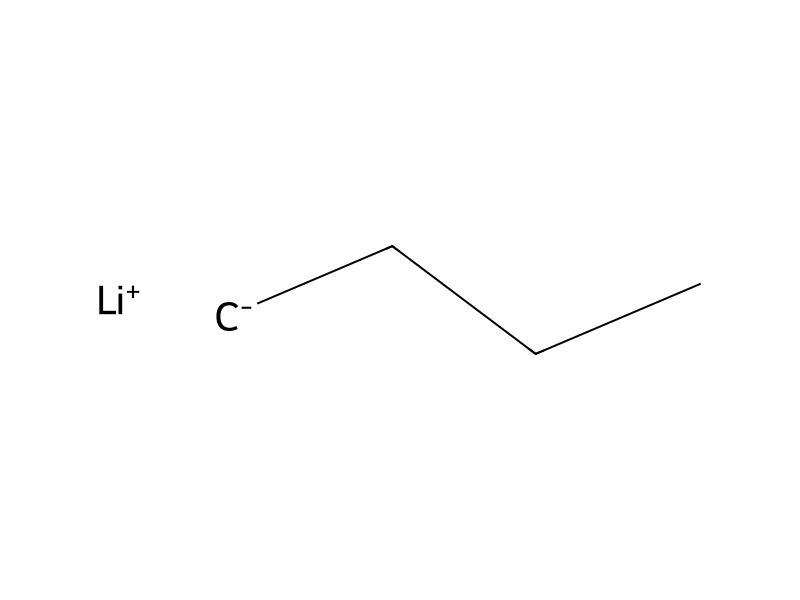
[Br:1][C:2]1[CH:7]=[CH:6][CH:5]=[C:4]([F:8])[CH:3]=1.C([N-]C(C)C)(C)C.[Li+].[Li+].CCC[CH2-].C(NC(C)C)(C)C.Cl.C1C[O:33][CH2:32]C1>O.CC(OC)(C)C.C(O)(=O)C.CN(C=O)C>[Br:1][C:2]1[CH:7]=[CH:6][CH:5]=[C:4]([F:8])[C:3]=1[CH:32]=[O:33]Participants
Reactant 6





Product 1

Reagents, catalysts & solvents 4




Procedure
1-Bromo-3-fluorobenzene (17.3 g, 100 mmol) was added over 5 minutes to a solution of lithium diisopropylamide (prepared from the addition of 40 mL of 2.5 N-butyllithium in hexanes to 11.5 g of 0.1 M diisopropylamine at 0° C.) in THF at −70° C. The mixture was stirred cold for 1 hour, after which DMF (8 mL) was added over 10 minutes. The mixture was stirred at −70° C. for an additional 40 minutes, followed by treatment with acetic acid (26 g). The mixture was allowed to warm to ambient temperature and transferred into a mixture of MTBE (200 mL), water (200 mL), and hydrochloric acid (4 N, 150 mL). The layers were partitioned and the organic portion was concentrated under reduced pressure to provide the title compound. MS (DCI/NH3) m/z 202 (M+H)+.
Workup
- stirringThe mixture was stirred at −70° C. for an additional 40 minutes
- customThe layers were partitioned
- concentrationthe organic portion was concentrated under reduced pressure
Sources & evidence
- ORD record
- ord-ce9da09e34014a23b35191568c769192
- Source dataset
- uspto-grants-2014_08
- Patent number
- US08802711B2
Reaction notes
Loading…