Triethylamine → 5-((Trimethylsilyl)ethynyl)picolinaldehyde
Reaction equation

Br[C:2]1[CH:3]=[CH:4][C:5]([CH:8]=[O:9])=[N:6][CH:7]=1.[Si:10]([C:14]#[CH:15])([CH3:13])([CH3:12])[CH3:11].C(N(CC)CC)C.C(OCC)(=O)C>C1COCC1.[Cu](I)I.Cl[Pd](Cl)([P](C1C=CC=CC=1)(C1C=CC=CC=1)C1C=CC=CC=1)[P](C1C=CC=CC=1)(C1C=CC=CC=1)C1C=CC=CC=1.C1(P(C2C=CC=CC=2)C2C=CC=CC=2)C=CC=CC=1>[CH3:11][Si:10]([C:14]#[C:15][C:2]1[CH:3]=[CH:4][C:5]([CH:8]=[O:9])=[N:6][CH:7]=1)([CH3:13])[CH3:12]Participants
9
Reactant 4




Product 1

Reagents, catalysts & solvents 4



Conditions
- Temperature
- 100 °C
Procedure
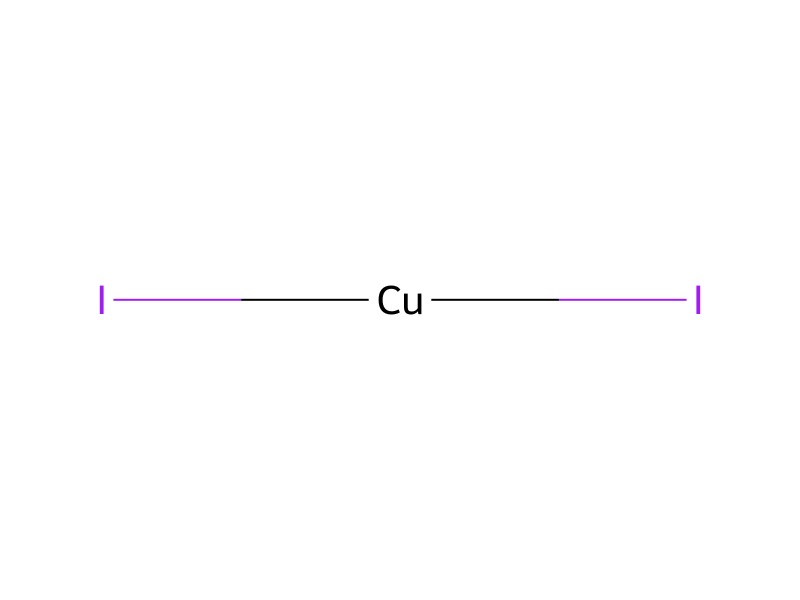
A solution of 5-bromopicolinaldehyde (1 g, 5.3 mmol), TMS-acetylene (1.04 g, 10.6 mmol) and triethylamine (4 mL) in THF (10 mL) was purged with argon for 10 min. Copper iodide (76 mg, 0.4 mmol), Pd(PPh3)2Cl2 (141 mg, 0.4 mmol) and triphenylphosphine (0.1 g, 0.4 mmol) was added and the mixture was heated to 100° C. under microwave irradiation for 10 min. Ethyl acetate (200 mL) was added at the solution was washed with water (2×25 mL), dried over MgSO4 and concentrated to dryness. The residue was filtered through silica gel with CH2Cl2 to give the title compound as a yellow oil (1 g, 95%). 1H NMR (400 MHz, CDCl3) δ 10.08 (s, 1H), 8.82 (s, 1H), 7.91 (s, 2H), 0.29 (s, 9H).
Workup
- washwas washed with water (2×25 mL)
- dry with materialdried over MgSO4
- concentrationconcentrated to dryness
- filtrationThe residue was filtered through silica gel with CH2Cl2
Sources & evidence
- ORD record
- ord-e17742ee76924178b997af3a3d2e6d96
- Source dataset
- uspto-grants-2013_07
- Patent number
- US08481525B2
Reaction notes
Loading…